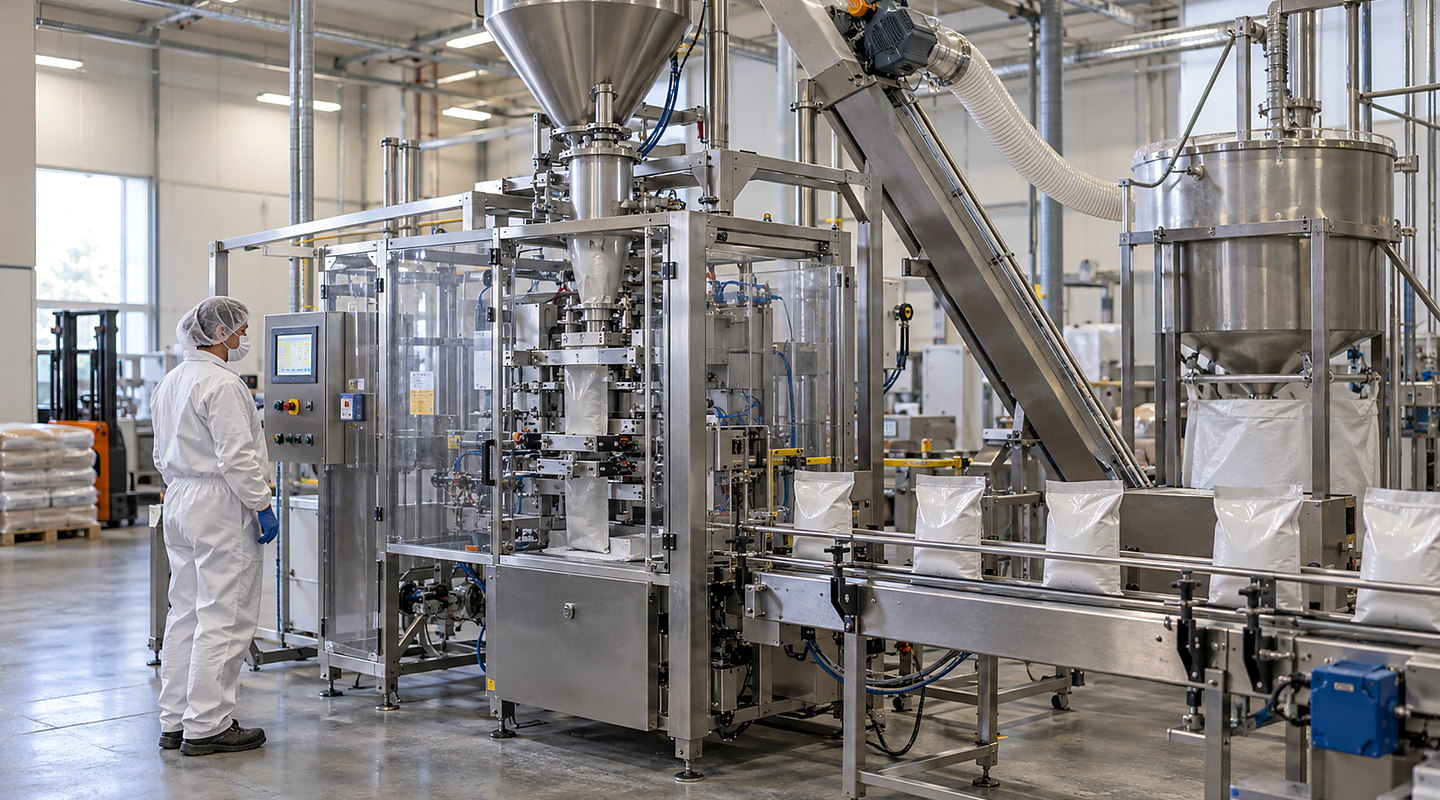
Flour Bagging Machines Selection Guide
Compare flour bagging routes using product flow, bag construction, target weights, accepted output, cleaning access and finished-bag checks.
Choose flour bagging machines by how well each option handles your real variation, line connections, safe access, maintenance and required results—not headline speed alone.
For routine production using flour weighing and bagging, a short trial that reproduces the difficult condition is often more useful than a long list of nominal specifications.
Compare options in the conditions where they must work — Flour Bagging Machines
Plan flour bagging machines around your product, pack range, target output, cleaning needs and finished-pack checks. Discuss a practical line concept with Lancing using representative samples. A useful shortlist should show how every option copes with flour weighing & bagging product behaviour and cleaning, access and changeover method.
Discuss your application

Ask every supplier the same questions
| Decision | What to ask | What to check |
|---|---|---|
| Flour Weighing & Bagging Product Behaviour | How does the intended flour behave during hopper loading, dosing and discharge? | Use representative normal and difficult samples; record bridging, settling and dusty handling. |
| Bag Construction, Size and Closing Method | How will each bag size and construction be presented, filled and transferred to closing? | Trial empty and filled examples; inspect bag-mouth presentation and the closing result. |
| Target Bag Weights and Weight Checks | What target net weights and allowed variation must be demonstrated? | Agree tare, filled-weight checks and the sample record before comparing results. |
| Required Output and Production Pattern | What accepted bags per hour are needed across the complete filling and closing route? | Include refill, batch length, cleaning and short stops in the recorded production pattern. |
| Cleaning, Access and Changeover Method | How will the actual product changes, emptying and site cleaning procedure be checked? | Review access to product-contact parts and the first accepted bags after restart. |
| Finished-Pack Checks and Reject Handling | What bag condition, closing checks and reject response define an accepted result? | Agree weight and closing records, reject handling and checks before production resumes. |
Include simpler approaches to flour weighing and bagging in your shortlist
| Approach | Often suitable when | Watch for |
|---|---|---|
| Flour Bagging Machines | You need a dedicated solution for a clearly defined duty, product or part range and line interface. | Food-contact, hygiene and allergen controls must be validated for the actual product and site. |
| Semi-Automatic Equipment for Lower-Volume or High-Changeover Work | Your volumes, product mix or operator judgement make a simpler route more practical. | Check ergonomics, consistency and safe access before choosing the lower-complexity option. |
| Fully Automatic Line Integration where Repeatable Container Flow and Rate Justify It | Your surrounding process is stable enough for a broader automated solution to add value. | Allow for line connections, fault recovery and maintenance as well as the headline equipment. |
Pause before choosing when…
- Only perfect or hand-selected examples of routine production using flour weighing and bagging are available.
- No one has defined how finished-pack checks and reject handling will be evaluated.
- The normal range for flour weighing & bagging product behaviour is described only as “usually fine” but has not been bounded.
- Your operator, cleaning, maintenance or recovery access has not been considered.
- Quoted performance depends on another machine or data source that is not included.